Galaxy Tabular Learner: Building a Model using Chowell clinical data
Contributors

 Paulo Cilas Morais Lyra Junior
 Junhao Qiu
 Jeremy Goecks
Questions
How can Tabular Learner in Galaxy be used to reconstruct a LORIS-style (LLR6) logistic regression model using the same dataset and predictor set?
How should the decision threshold be configured (default vs selected cutoff) to align predictions with the intended clinical operating point?
Which components of the Tabular Learner report best support a transparent comparison to the published LORIS baseline?
Objectives
Build an immunotherapy-response classifier in Galaxy using Tabular Learner.
Train and compare candidate models, then re-evaluate with a selected probability threshold.
Benchmark discrimination, calibration, and threshold-dependent metrics against the published LORIS LLR6 model.
What you will do
- Upload preprocessed Chowell_train and Chowell_test tables (Zenodo).
- Train a classification model with Tabular Learner in Galaxy.
- Re-evaluate the selected model at a chosen probability threshold.
- Use the HTML report to compare results to LORIS LLR6 (Chang et al., 2024).
Speaker Notes
This tutorial treats the published LORIS LLR6 model as a benchmark baseline. The main goal is to understand what changes (and what does not) when the model is rebuilt under a standardized Galaxy workflow.
Tool availability
- Tabular Learner is available on:
- Cancer-Galaxy (Galaxy-ML tools → Tabular Learner)
- Galaxy US (Statistics and Visualization → Machine Learning → Tabular Learner)
Use case: LORIS LLR6 (Chang et al., 2024)
- Task: Predict patient benefit from immune checkpoint blockade (ICB) therapy.
- Model: Logistic regression (LLR6) trained on 6 predictors.
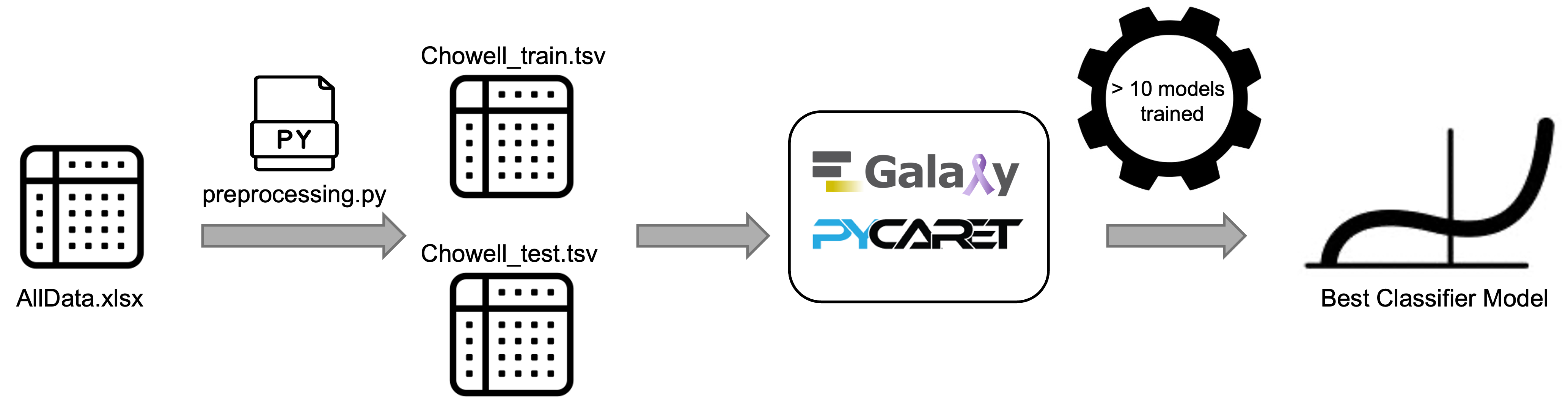
- Data: LORIS PanCancer; this tutorial uses Chowell_train (train) and Chowell_test (test).
Dataset and predictors
Predictors (LLR6):
- TMB (truncated at 50)
- Systemic Therapy History (0/1)
- Albumin
- Cancer Type (one-hot encoded)
- NLR (truncated at 25)
- Age (truncated at 85)
Target:
- Response (0 = no benefit, 1 = benefit)
Model selection idea
Tabular Learner can:
- Compare multiple candidate classifiers and pick the best under its evaluation protocol.
- Restrict candidates to a specific family (e.g., logistic regression only).
In this tutorial, we train all candidate models and check whether logistic regression remains among the best performers.
Data upload
Import the preprocessed TSV files from Zenodo:
Chowell_train_Response.tsvChowell_test_Response.tsv
Ensure the datatype is tabular, and optionally tag datasets for traceability.
Speaker Notes
The tutorial focuses on the preprocessed tables; a separate notebook/script performs the truncation and encoding steps.
Run 1: Train and select a best model
Tabular Learner parameters:
- Input Dataset:
Chowell_train_Response.tsv - Test Dataset:
Chowell_test_Response.tsv - Target column:
Response - Task:
Classification
Run the tool to produce the Best Model and the HTML report.
Run 2: Re-evaluate at a selected threshold
Rerun Tabular Learner with:
- Customize Default Settings?: Yes
- Classification Probability Threshold: 0.25
Speaker Notes
Threshold-dependent metrics (accuracy, precision, recall, F1, MCC) change with the cutoff. This second run makes threshold choice explicit for comparisons.
Outputs to inspect
- Tabular Learner Best Model (
.h5): trained model + preprocessing. - Tabular Learner Model Report (HTML): setup, validation, test metrics, plots.
- (Optional) best_model.csv (hidden): selected hyperparameters.
Report structure
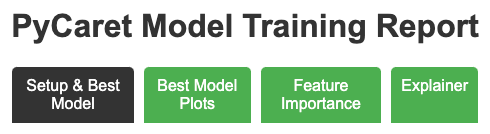
The report has four tabs:
- Model Config Summary: data split + run settings + chosen threshold + best model hyperparameters.
- Validation Summary: cross-validation table and diagnostic plots (e.g., calibration, threshold plot).
- Test Summary: holdout/test metrics and ROC/PR/confusion matrix plots.
- Feature Importance: coefficients/importance + SHAP/permutation/PDPs where available.
Benchmarking approach
Separate metrics into:
- Threshold-independent
- ROC-AUC, PR-AUC (compare discrimination without choosing a cutoff)
- Threshold-dependent
- Accuracy, F1 (report together with the selected cutoff)
Use the report to check:
- split strategy and evaluation protocol
- calibration and probability diagnostics
- threshold plot (precision/recall/F1 vs cutoff)
Key numbers
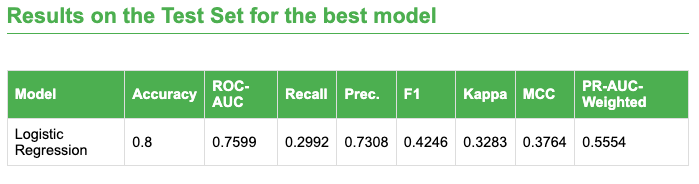
| Model | Threshold | Accuracy | ROC-AUC | PR-AUC | F1 |
|---|---|---|---|---|---|
| LLR6 (reference) | 0.30 | 0.68 | 0.72 | 0.53 | 0.53 |
| Tabular Learner Run 1 | 0.50 | 0.80 | 0.76 | 0.55 | 0.42 |
| Tabular Learner Run 2 | 0.25 | 0.67 | 0.76 | 0.55 | 0.52 |
Interpreting the differences
- Both Tabular Learner runs show higher ROC-AUC/PR-AUC than LLR6, suggesting similar-or-better discrimination.
- Changing the threshold shifts the operating point:
- Run 1 (0.50): higher accuracy, lower F1
- Run 2 (0.25): lower accuracy, higher F1
- Check calibration to see whether probability scores are over/under-confident.
Conclusion
- Tabular Learner enables a reproducible workflow to:
- train, compare, and select models on tabular clinical data
- evaluate discrimination, calibration, and threshold effects via a single report
- Threshold choice must be justified because it can change clinical tradeoffs (false positives vs false negatives).
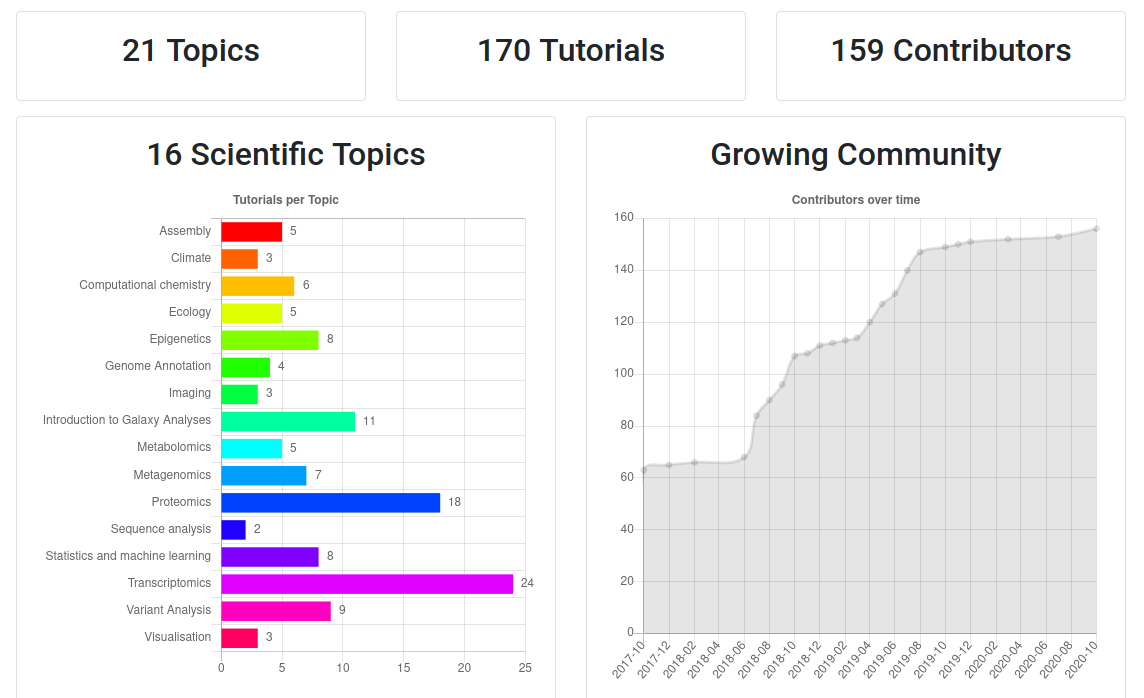
Galaxy Training Resources
- Galaxy Training Materials: training.galaxyproject.org
- Help Forum: help.galaxyproject.org
- Events: galaxyproject.org/events
Thank you!
This material is the result of a collaborative work. Thanks to the Galaxy Training Network and all the contributors! Tutorial Content is licensed under
Creative Commons Attribution 4.0 International License.
Tutorial Content is licensed under
Creative Commons Attribution 4.0 International License.